

By Gerardo Peña, Founder & CEO at Made.
Updated September 2026
The Architecture That Lets Predictive AI Scale Without Losing Accuracy
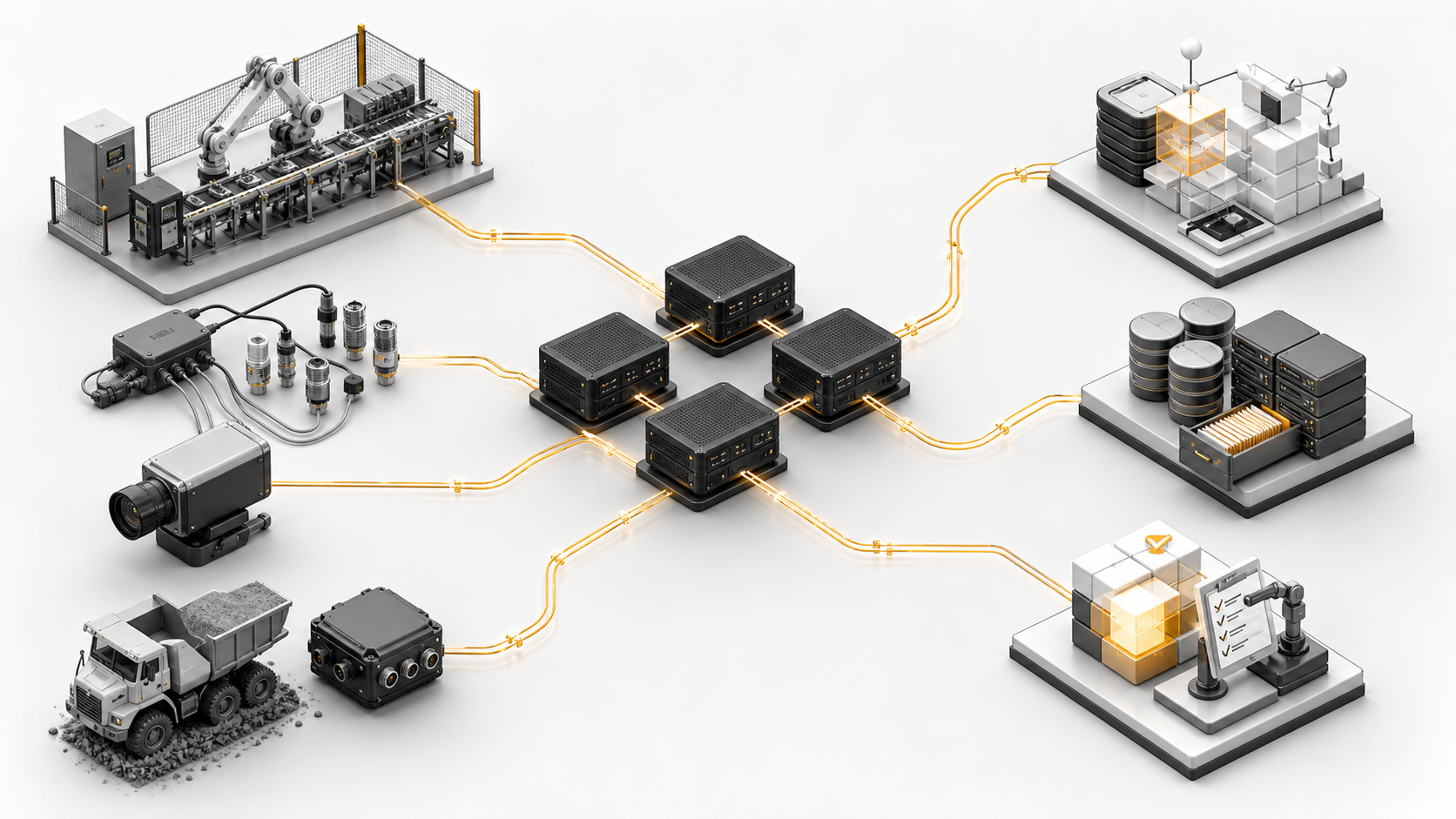
At MadeOS, we designed the architecture that lets predictive and prescriptive AI scale with the operation: from a single machine to an entire plant, without losing accuracy along the way.
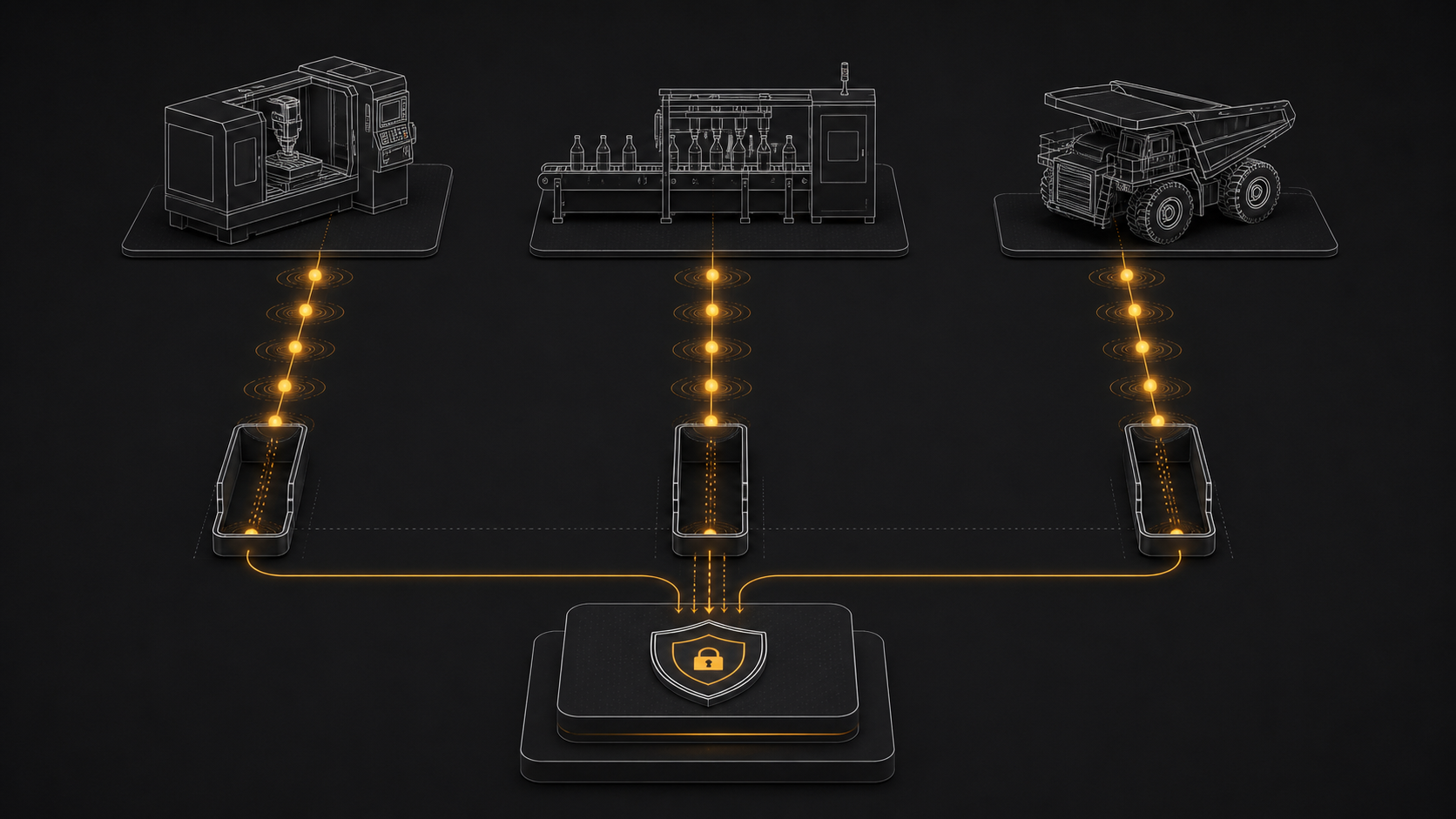
This is possible because every signal preserves its identity, sequence, and context from the asset that produces it all the way to the action it informs.
For an operation with multiple machines, gateways, or vehicles, this means processing volume without losing the link between event, asset, sequence, and decision.
An industrial platform shouldn’t treat a signal as “decision-ready” just because it was received. It must prove its identity, integrity, sequence, operational context, and link to the resulting action.
At MadeOS, this translates into a chain of trust made up of five elements: asset, event, sequence, processing, and action. If one breaks, an alert can be technically valid but operationally unreliable.
MadeOS uses a Kafka-based event streaming architecture to process telemetry from multiple devices at scale. Properly configured, this architecture preserves sequence per asset, supports resilient delivery, and maintains a history that helps audit how a signal became an operational action.
What breaks when scale grows without the right architecture
A CNC machine, a bottling line, or a heavy-duty vehicle can generate thousands of events during a single operating cycle. Temperature, vibration, PLC states, images, RPM, motor load, and service events are only useful if they’re processed with the order and context needed to interpret them.
When the pipeline isn’t designed for this volume, duplicate events inflate a real condition, delayed events arrive after the action they were meant to inform, sequences end up incomplete, and traceability is lost between the origin signal, processing, and final persistence. The cost isn’t technical: it’s false alerts, wasted diagnostic time, unnecessary maintenance, and, in the worst case, a shutdown that could have been anticipated.
Example: an alert isn’t reliable without sequence
A packaging line logs three events from a critical motor: a temperature increase at 10:01:12, a speed reduction at 10:01:45, and a stop at 10:03:09.
If the speed-reduction event arrives late or gets assigned to the wrong asset, a platform might interpret the stop as an isolated event rather than the culmination of a progressive thermal condition.
MadeOS preserves a stable key per asset, origin timestamps, event identifiers, and, when the device allows it, sequence counters. This makes it possible to detect repeated, delayed, or out-of-order events before they’re used to prioritize an action. The result isn’t just another temperature alert; it’s operational evidence to decide whether the condition requires inspection, controlled load reduction, or scheduled maintenance.
What Kafka brings to a telemetry architecture
Kafka is an event streaming platform that logs events in durable, distributed streams. At MadeOS, it decouples the arrival of telemetry from physical assets from downstream processing, analysis, and persistence. This helps absorb volume changes without turning every signal spike into a direct dependency between the device and the database.
Kafka doesn’t remove the need for good edge, gateway, and application integration. It provides a foundation for handling flow in a repeatable, observable, and recoverable way.
Kafka solves the stream; it doesn’t solve operational context on its own. It offers a durable event log, order within a partition, and replay capability. But it doesn’t know on its own which asset a message represents, whether a timestamp came from the device or the gateway, whether a signal corresponds to a physically possible condition, or whether a recommendation was actually executed. That layer of industrial semantics requires an asset model, signal schemas, quality rules, and an explicit link between event, evaluation, and action. This is the architecture that lets MadeOS’s prediction and prescription scale with the operation, not against it.
Event integrity and delivery
Integrity isn’t just about storing a message. It means knowing that the received event corresponds to the correct asset, matches the expected schema, and reached the pipeline before being used for a decision.
A reliable Kafka implementation combines write acknowledgments, replication, retries, and producer idempotency to reduce the risk of loss or duplication during transient failures. Final persistence must also confirm processing before marking an event as consumed.
Order per device, asset, or vehicle
Order is essential when the meaning of an event depends on the one before it. A temperature increase, followed by a derate, followed by a stop, shouldn’t be interpreted the same way if the sequence arrives reversed.
Kafka preserves order within a partition. To maintain a sequence per device, events from the same asset must use a stable key, such as a machine, gateway, or vehicle identifier. This way, that asset’s stream is processed on a single partition and keeps its arrival order.
This doesn’t imply global order across all assets. It also doesn’t automatically correct messages generated out of sequence by a disconnected device. That’s why MadeOS preserves event identifiers, origin timestamps, and, when applicable, sequence counters to detect transmission anomalies.
Traceability from signal to action
Auditability starts with a simple question: what data led to this recommended action?
An auditable telemetry architecture must be able to relate the originating asset, device, or gateway; the signal and the moment it was emitted; the event persisted within the stream; the processing, model, or rule that evaluated it; and the recommendation, alert, or action it produced.
This traceability makes it possible to review anomalies, investigate delays, reprocess events when logic improves, and explain to an operations team why a condition was prioritized.
Capabilities your architecture needs to scale prediction and prescription
Before connecting more assets, a team should be able to answer:
— Identity: does every event include a stable asset, device, or gateway key?
— Schema: is the structure and unit of each signal validated before processing?
— Sequence: are there origin timestamps and, when applicable, sequence counters?
— Delivery: what happens if connectivity drops or the consumer stops?
— Deduplication: how is the same event prevented from being processed twice?
— Persistence: when is an event confirmed as actually processed?
— Audit: can the evidence behind an alert be reconstructed?
— Observability: are lag, latency, errors, and failures monitored, with clear ownership?
— Replay: can history be reprocessed when a new rule or model is introduced?
Operational metrics matter as much as design: delivery rate, duplicate events, consumer lag, persistence time, failure rate, and recovery time are the evidence that the pipeline is keeping pace with the operation, rather than becoming another source of uncertainty.
From data streaming to Zero-Loss Operations
Kafka doesn’t replace operational intelligence. It enables a more reliable data layer on top of which MadeOS can connect physical signals with context, risk, and action. The goal isn’t to accumulate events or store more signals.
Build a baseline for operational loss
Connect your critical asset or system, identify available signals, and define the first loss MadeOS should help prevent: https://madeos.ai/en/#mady
Technical note
Final guarantees around delivery, idempotency, order, and replay depend on the configuration of the producer, topics, replicas, consumers, gateway, and persistence layer in each deployment. This article describes the architecture and controls MadeOS evaluates, not a universal guarantee for every environment.
Frequently asked questions
How does MadeOS keep telemetry reliable across multiple assets?
MadeOS uses a Kafka-based event streaming architecture to process telemetry from multiple devices. The pipeline associates events with their originating asset, supports resilient processing, and allows monitoring of delivery, delay, and persistence as the operation scales.
Does Kafka preserve the order of signals from each device?
Kafka preserves order within a partition. By using a stable key per device, machine, or vehicle, MadeOS can process that asset’s sequence in arrival order. Timestamps and event identifiers complement that sequence to detect delays or out-of-order events.
Can MadeOS audit an action back to its origin signal?
Yes. The architecture is designed to relate the asset, the originating event, the processing, and the recommended action. That traceability makes it possible to investigate what happened, when it happened, and what context supported an operational decision.