
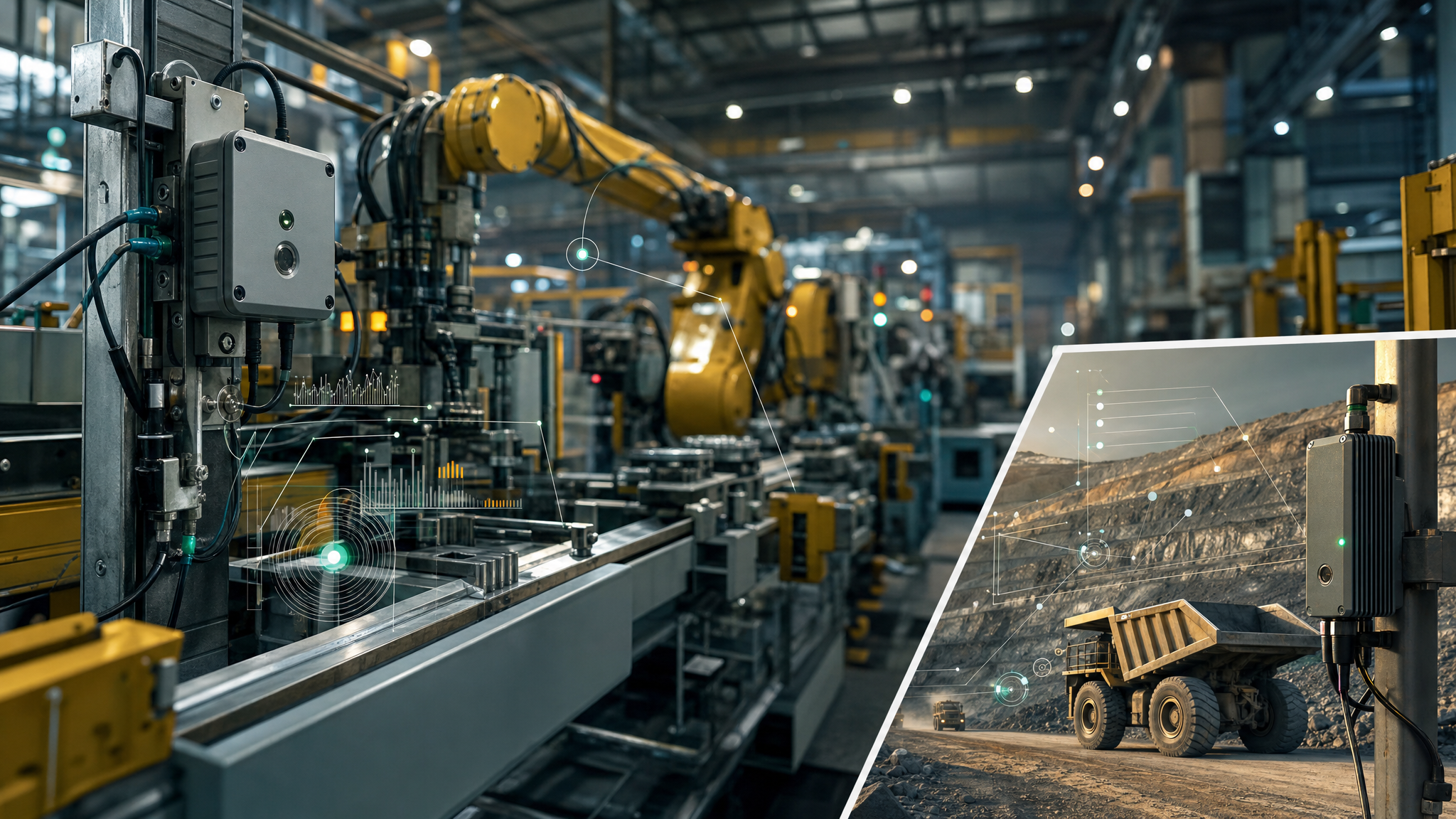
Signal to Action by Made: The Physical World Is Becoming Modelable
Description: The first Signal to Action brief on Physical AI, industrial sensors, edge intelligence, and the shift toward modelable operations. Slug: signal-to-action-physical-world-becoming-modelable Locale: en
Industrial AI is moving into a new phase.
The first wave digitized reports. The second connected machines. The next one will model the physical world itself: assets, sensors, processes, constraints, failures, quality signals, human workflows, and operating context.
That shift matters because industrial advantage will increasingly come from how fast a company can turn physical signals into better operational decisions.
This is the lens for Signal to Action by Made: not more AI hype, not another dashboard category, but the practical movement from industrial signals to operational intelligence.
1. Physical AI is leaving the lab and entering production systems
Kuka has launched its AI-powered Automation Management Platform at its Toledo, Ohio production facility, according to PlasticsToday. The deployment connects existing automation infrastructure with AI capabilities in a 335,000-square-foot operation producing more than 300 vehicle bodies daily. The article frames the move as Physical AI entering real manufacturing environments, not just demos.
Why it matters:
Physical AI becomes strategically important when it touches existing production systems. The hard part is not showing that AI can reason in a controlled demo. The hard part is connecting AI to legacy automation, work cells, robots, devices, production targets, constraints, and quality requirements without breaking operational trust.
Made take:
The industrial AI category is shifting from isolated algorithms to orchestration layers. The winners will not only analyze data. They will understand the operating environment well enough to recommend, prioritize, and eventually coordinate action.
2. Edge compute is becoming ready for foundation models in physical environments
NVIDIA introduced new Jetson Thor computers for robotics and edge AI, including compact modules intended to run advanced robotics, visual AI, and edge workloads on power-efficient systems. NVIDIA also describes Cosmos 3 Edge, a lightweight world foundation model for embodied systems, designed for real-time on-device inference.
Source: https://blogs.nvidia.com/blog/jetson-thor-robotics-edge-ai-agent/
Why it matters:
Industrial environments cannot assume perfect cloud connectivity, low latency, or permissive data movement. If models are going to reason over machines, sensors, video, and process signals, more intelligence needs to live close to the operation.
Made take:
Edge AI is not just an infrastructure choice. In industrial settings, it is a trust architecture. Keeping inference near the physical process can reduce latency, preserve sensitive operational data, and make AI more compatible with restrictive OT environments.
3. IO-Link shows why sensor infrastructure is becoming a data strategy
A3’s Motion Control & Motor Association describes IO-Link as a way to simplify connections between industrial networks and sensors or actuators on the factory floor. The piece highlights diagnostic data, predictive analytics, device health, traceability, and lower complexity compared with traditional PLC wiring approaches.
Why it matters:
Sensors are often treated as instrumentation. That is too narrow. In a modelable operation, sensors become the entry point for learning what is actually happening in the physical system: vibration, temperature, pressure, position, cycle behavior, abnormal states, and device health.
Made take:
The sensor layer is becoming strategic because AI is only as useful as the physical signals it can see. IO-Link matters not because it is fashionable, but because it lowers the friction of collecting richer machine context at scale.
4. Mining automation is moving toward open, mixed-fleet deployment
Hitachi Construction Machinery and Pronto signed an MoU to advance open mine automation solutions. Mining Technology reports that the partnership is aimed at practical, scalable solutions for productivity and safety, including autonomy that can work with existing mixed fleets instead of locking operators into one proprietary ecosystem.
Source: https://www.mining-technology.com/news/hitachi-pronto-mou-mine-automation-solutions/
Why it matters:
Mining operations are too capital-intensive and heterogeneous for clean-slate automation assumptions. The future of industrial intelligence has to work with the assets already in the field: mixed OEM fleets, harsh environments, fragmented data, variable connectivity, and site-specific operating rules.
Made take:
This is a useful reminder for all industrial AI: the system has to respect the installed base. Practical AI for mining and manufacturing will win by adapting to real operations, not by asking the operation to become a laboratory.
5. Physical AI adoption is still early, but expectations are rising
Deloitte’s Physical AI report argues that Physical AI is shifting from experimentation toward larger-scale deployment across manufacturing, logistics, robotics, and industrial operations. The gap between current transformation and expected transformation is the signal: many companies are not ready yet, but they increasingly believe the category will matter.
Source: https://www.deloitte.com/ap/en/about/press-room/physical-ai-powering-smart-manufacturing.html
Why it matters:
Early markets are often noisy. The important question is not whether every Physical AI claim is mature today. It is whether the industrial stack is reorganizing around a new assumption: physical operations can be measured, modeled, and improved continuously.
Made take:
The opportunity is not to add AI as a feature. The opportunity is to build the operating layer that helps industrial teams learn from their physical systems.
What operators should watch
- Whether AI deployments connect to real production systems or remain isolated pilots.
- Whether sensor investments produce actionable context, not just more raw data.
- Whether edge compute becomes a requirement for sensitive or latency-bound operations.
- Whether industrial AI platforms work with existing assets and mixed environments.
- Whether models can explain, prioritize, and support decisions that operators actually trust.
Made perspective
The physical world is becoming measurable, modelable, and intelligent.
For industrial companies, this does not mean replacing operational discipline with AI speculation. It means building the data, sensor, edge, and model infrastructure needed to understand operations with more precision.
The next advantage will belong to teams that can move from signal to action faster than their competitors.