

System One in Made OS
Industrial operations generate more data than any person can evaluate in real time.
Every asset produces signals about its condition and performance: temperature, vibration, current, pressure, speed, PLC events, CAN/J1939 frames, work orders, maintenance interventions, and process constraints. The challenge has never been limited to capturing those signals. It is interpreting them in the right context and responding before a deviation turns into loss.
Made OS was built to address that challenge.
Its role does not end with surfacing an anomaly or summarizing an incident. It builds a representation of the operational state, evaluates which conditions require attention, and guides the most appropriate intervention within the physical and operational constraints of each environment.
A new paradigm for physical AI
Physical AI is not a robot with a chat window.
It is intelligence that understands the state of a real operation, makes decisions within physical and safety constraints, and improves through the consequences of its actions.
System One Models make this possible at a new economic and operational scale.
When machine judgment becomes fast and affordable enough to run across every relevant state transition, AI no longer samples an operation occasionally. It can evaluate the operating cycle continuously.
That is the paradigm shift.
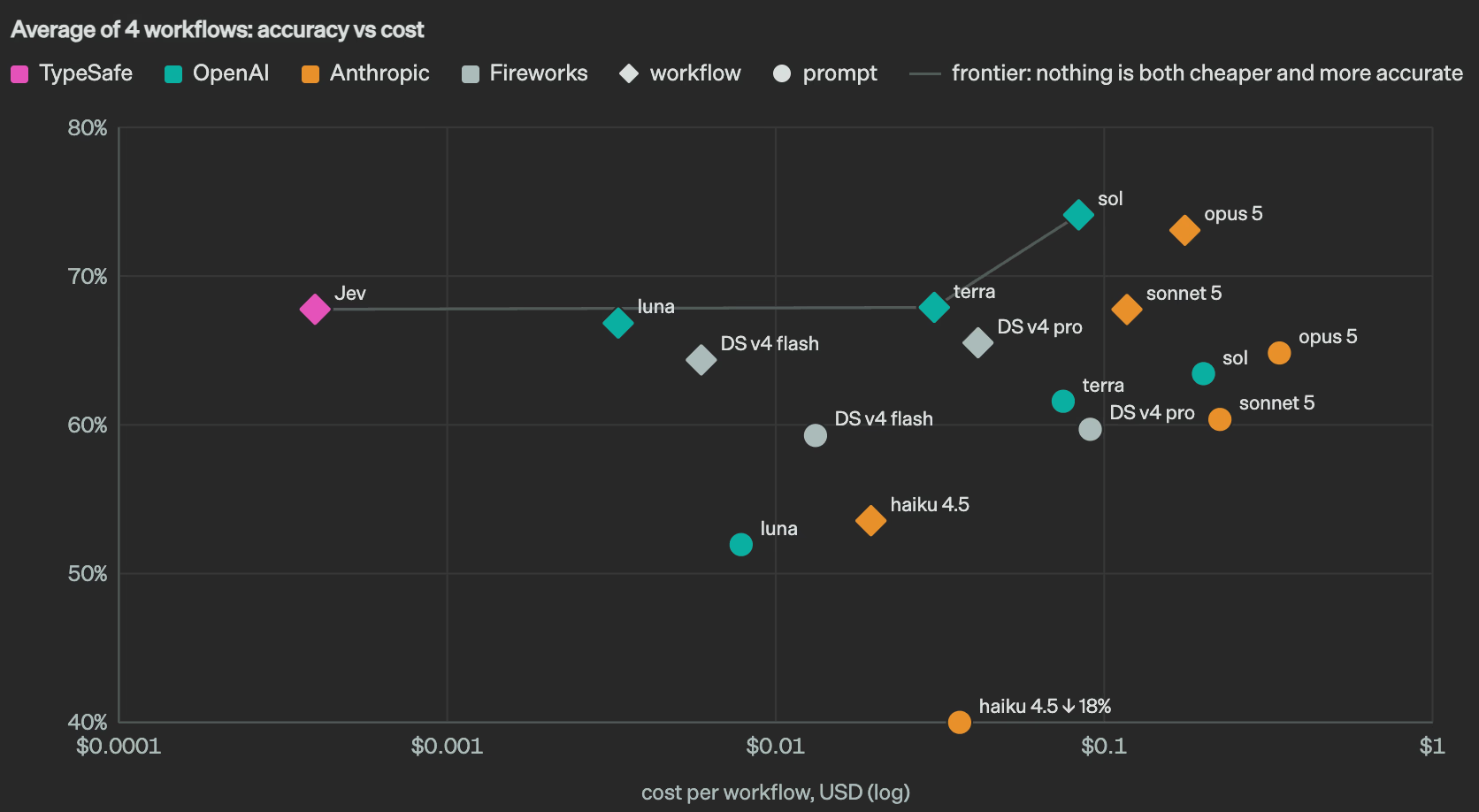
With System One Models, Made OS adds a new intelligence layer to this architecture.
System One Models produce fast, typed, probabilistic decisions that software can consume directly. Jev, by TypeSafe AI, uses parallel structured inference to transform unstructured context into a constrained output: a decision within a defined space, accompanied by a calibrated confidence signal. TypeSafe presents this approach as a frontier intelligence function built for decisions rather than a conversational interface.
Intelligence for each layer
Industrial operations require different forms of intelligence.
Generative models provide an essential capability: they turn data, events, and technical decisions into language that people can understand. In Made OS, this enables prescriptive notifications that give operators the context they need: what changed, which condition was identified, why it matters, what action is recommended, and how urgent it is.
Generative models are also valuable for research, technical knowledge retrieval, incident synthesis, documentation, and specialist-assisted analysis.
System One addresses a different requirement: generating structured outputs for recurring evaluations within the operating cycle. The question is defined against explicit criteria; the response arrives in a format that Made OS can validate, integrate into a workflow, and handle according to the rules of each facility.
Within Made OS, both capabilities work on the same operation from different layers.
| Layer | Responsibility |
|---|---|
| System One | Evaluates the operational state and returns a structured decision with a confidence signal |
| Rules and deterministic logic | Applies physical constraints, safety policies, criticality, and execution conditions |
| LLMs | Turns the prescription into natural language, expands context, and assists the operator or specialist |
The architecture matters because communication, probabilistic judgment, and execution impose different requirements.
The operational state
Telemetry alone describes measurements. An elevated temperature, a vibration change, or a current increase do not carry the same meaning across every asset or at every point in its operating cycle.
Made OS transforms these signals into an operational state. That state incorporates asset behavior, load, production conditions, recent history, pending maintenance, established limits, and actions already underway.
MadeIO connects this information through industrial protocols such as OPC UA, Modbus, and CAN/J1939. From there, Made OS can evaluate conditions that matter to operational continuity: deviations from the expected pattern, combined signs of degradation, conditions that increase operating risk, or interventions that require prioritization.
System One evaluates that context through specific questions:
-
Is the current behavior within the expected pattern for this asset?
-
Does the combination of load, vibration, temperature, and operating time warrant an inspection?
-
Is there enough risk to change maintenance priority?
-
Can the asset continue operating within defined limits?
-
Does this case require human confirmation before any action is taken?
The precision of the questions matters as much as the model answering them. A strong architecture does not ask for a general conclusion about an asset. It asks for a bounded evaluation connected to a specific operational decision.
An output built for operations
System One expresses decisions in formats that Made OS can use consistently.
-
Choice: a selection among defined actions, such as monitor, inspect, reduce load, schedule maintenance, or escalate.
-
Score: an estimate of risk or severity for a specific condition, such as bearing degradation, overload, process drift, or quality loss.
-
Noul: a probabilistic binary assessment of an operational condition, such as whether an asset remains within its safe operating pattern or requires attention during the shift.
Structured output allows an evaluation to move through the rest of the architecture without first converting a textual answer into an operational instruction.
That does not mean model output is executed directly.
In Made OS, a System One decision passes through deterministic logic, safety policies, risk thresholds, asset criticality, and workflow controls. The model’s evaluation informs the response; the operating conditions configured for the site determine what may happen next.
Physical signals
→ Operational state
→ System One evaluation
→ Safety rules and workflow
→ Validated prescription
→ Natural-language notification
→ Operator action or authorized automation
→ Operational feedback
The resulting prescription combines two elements: an operationally bounded decision and an explanation that enables the responsible person to understand it and act with judgment.
Validation in Made OS
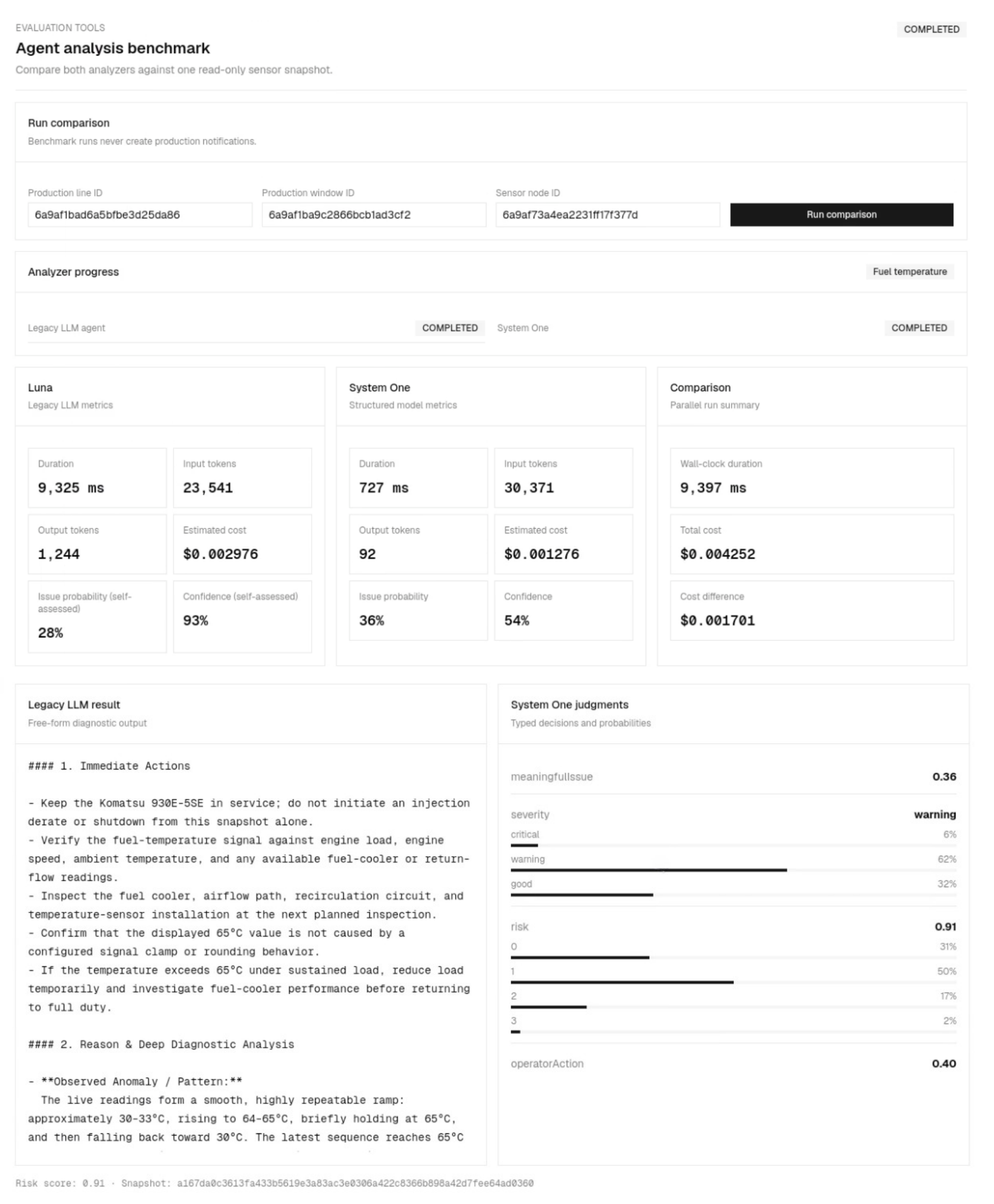
We integrated System One into a Made OS predictive-maintenance workflow to evaluate the full process: telemetry analysis, condition determination, prescription generation, and operator notification.
In this test, a workflow based primarily on generative analysis required approximately two minutes to complete. Integrating System One reduced the total time for analysis and prescription generation to approximately six seconds.
The result reflects an improvement in workflow design, not only inference speed.
The evaluation arrives with criteria defined in advance—such as severity, intervention type, or escalation requirement—and with explicit probability and confidence signals. Made OS can then apply operational policies before turning that evaluation into a prescription for the plant team.
This result comes from a specific test within the Made OS pipeline.
Performance depends on factors including data quality and availability, asset configuration, operating rules, condition criticality, and deployment infrastructure.
Confidence as an operational variable
Structured output makes software integration easier. Structure alone, however, does not equal certainty.
Model confidence should be interpreted as a statistical signal. TypeSafe describes calibration as the relationship between the confidence expressed by the model and the accuracy observed across comparable groups of predictions. A confidence level of 70% means that, in aggregate and under evaluation, roughly seven out of ten decisions carrying that signal should be correct.
A single prediction can still be wrong even when the model expresses high confidence. Made OS therefore does not treat confidence as an independent authorization to act.
The signal is assessed alongside operational risk, asset criticality, safety limits, and the rules governing each workflow.
That combination makes it possible to adapt the response to the context:
-
Low-risk condition with sufficient confidence: the system can activate a predefined workflow.
-
Relevant condition requiring human judgment: Made OS presents a prescription and requests confirmation.
-
Critical condition or insufficient signal: the case escalates to a specialist under the established protocol.
This approach preserves human accountability where the consequence or uncertainty warrants expert intervention. It also reduces the burden of manually evaluating recurring, high-frequency conditions.
Operations that anticipate
A plant does not become more intelligent by accumulating more alerts.
It becomes more intelligent when it can recognize which conditions deserve attention, understand the consequence of allowing them to progress, and guide a response before the impact materializes as downtime, quality loss, or reduced throughput.
That is the role of System One within Made OS: to turn dispersed signals into structured operational judgment, carry that judgment through rules, limits, and workflows, and give each person the information required to act with clarity.
Industrial autonomy does not mean removing human judgment. It means applying the appropriate level of oversight to every decision based on its risk, while freeing plant teams from manually chasing every variation in a system that never stops changing.
Made OS advances its mission to bring industrial operations toward Zero-Loss Operations: operations that detect earlier, intervene with greater precision, and learn from every outcome while remaining grounded in physical constraints, safety, and the accountability of the people who run them.
The opportunity is not to automate a conversation.
It is to build operations that can anticipate.